May 12, 2021
Tiny air pollutants may come from different sources, but they all show a similar biased trend
Air pollution from fine particulate matter—extremely small bits of material like soot that can enter the nose and throat while breathing—can have deadly health consequences. One 2019 study of 4.5 million U.S. veterans estimated that nearly 200,000 people, of whom a disproportionate number were Black, died of causes associated with fine particulate matter (also known as…
Diversity, Equity & Justice | Health & Well Being | Policy & Law
May 10, 2021
Why a backyard that’s ‘for the birds’ is great for kids, too

Here’s something worth tweeting about: Being around more birds can boost your family’s happiness. A recent German study of more than 26,000 Europeans found that the cheeriest folks lived near natural areas with a wider diversity of bird species. And no need to know the difference between wood thrush and white-throated sparrow whistles—turns out simply seeing and hearing a variety of…
Health & Well Being | Natural Resources & Environment
May 7, 2021
What can our cities do for us? Columnist Rubén Casas has ideas
Originally written by Rubén Casas, Assistant Professor of rhetoric and composition at the University of Washington Tacoma, for Crosscut. Of the many insightful things Italo Calvino wrote about a city, the one that sticks with me the most is this one: “You take delight not in a city’s seven or seventy wonders, but in the answer…
Advocacy & Civic Engagement | Diversity, Equity & Justice | Land Use & Planning
May 5, 2021
Just Sustainabilities in a Post-Pandemic World: Virtual Symposium on May 27th
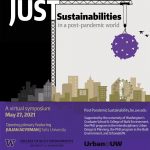
The COVID-19 pandemic has tested our cities’ adaptability and resilience and dug deeper holes in cities’ social, environmental and physical fabric. As we come out of the pandemic, we need to re-think how the city fabric functions. Planning for the post-pandemic city requires a careful understanding of the implications of the COVID19 pandemic on pre-existing…
Advocacy & Civic Engagement | Climate & Energy | Diversity, Equity & Justice | Food | Infrastructure & Transportation | Land Use & Planning | Natural Resources & Environment | Policy & Law
May 1, 2021
Deepfake tech takes on satellite maps
While the concept of “deepfakes,” or AI-generated synthetic imagery, has been decried primarily in connection with involuntary depictions of people, the technology is dangerous (and interesting) in other ways as well. For instance, researchers have shown that it can be used to manipulate satellite imagery to produce real-looking — but totally fake — overhead maps…
Data Science & Spatial Analysis | Innovation & Technology | Land Use & Planning | Security & Privacy
April 28, 2021
Urban Scholar Highlight: Jan Whittington
Jan Whittington is an Associate Professor of the Department of Urban Design and Planning, Director of the Urban Infrastructure Lab, Associate Director of the Center for Information Assurance and Cybersecurity, and Affiliate Faculty at the Tech Policy Lab. Her research applies transaction cost economic theory to networked infrastructures, such as transportation, water, and communication systems,…
Climate & Energy | Economy & Development | Land Use & Planning | Policy & Law
April 26, 2021
Gridlock is coming back. Noise doesn’t have to.
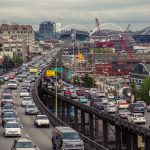
What does a city sound like? Asked that question, do you think of the dull roar of traffic, the staccato yelp of a horn, the wobbling screech of an alarm? In other words, do you think of cars? Automobiles are such a fixture of the urban landscape that it’s easy to overlook just how much…
Health & Well Being | Infrastructure & Transportation | Innovation & Technology
April 21, 2021
Building for sustainability
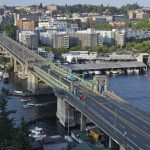
For civil engineering doctoral student Nathalie Thelemaque, it’s not enough to research how to design a building or a bridge. Thelemaque wants to know the impact of infrastructure systems on the climate and marginalized communities and help create more sustainable ones. It’s an issue so important that it even helped change her mind from considering a career in…
Climate & Energy | Diversity, Equity & Justice | Education | Infrastructure & Transportation
April 19, 2021
Urban@UW Leads Report on the Lessons and Levers for University Collaborations with Governmental and Community Partners
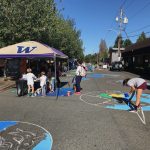
In the current era of multi-layered public health, environmental, and civic crises, creating and leveraging cross-sector partnerships to co-create solutions has never been more important. The Bullitt Foundation request for proposals (RFP) provided an unparalleled opportunity to implement and strengthen partnerships, and, equally important, to reflect on the relationships as a key pathway toward sustainability,…
Advocacy & Civic Engagement | Education
April 16, 2021
Planning the best route with multiple destinations is hard even for supercomputers – a new approach breaks a barrier that’s stood for nearly half a century
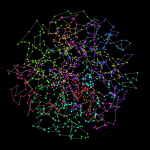
Originally written by Nathan Klein, PhD Student in Computer Science at the University of Washington. Computers are good at answering questions. What’s the shortest route from my house to Area 51? Is 8,675,309 a prime number? How many teaspoons in a tablespoon? For questions like these, they’ve got you covered. There are certain innocent-sounding questions,…
Data Science & Spatial Analysis | Innovation & Technology | Land Use & Planning